
How to Check Criminal History in Catahoula Parish
No public tool combines every Catahoula record. Start with the Seventh Judicial District Court file for charges that were prosecuted and their outcomes. The Catahoula Clerk of Court links to eClerks LA, but access depends on an account, the participating index, and available years. Call the clerk at 318-744-5497 when an older file or certified disposition is absent online.
Prepare the person's full name, date of birth when lawfully available, spelling variants, an approximate arrest or filing year, and a case or booking number if known. Match more than a name before relying on a result. A booking entry establishes custody intake; only the filed court record establishes what the prosecutor pursued and how each charge ended.
- Choose the record product: clerk case, sheriff booking, LA VINE custody, personal LSP history, registry profile, or federal docket.
- Search with a full name and the narrowest lawful identifiers the official system accepts.
- Compare dates, agencies, case numbers, and charge details before deciding that a result belongs to the intended person.
- Open the underlying booking or court file and trace every charge to a disposition.
- Order a certified clerk copy or use LSP Right to Review when an official personal record is required.
Why Catahoula Has No One-Click Search
“Criminal history” describes products with different purposes. A sheriff booking sheet records an accusation and intake. The clerk file shows whether a charge was filed and how it ended. LACCH joins fingerprint-supported Louisiana arrests with reported dispositions. LA VINE answers a narrower custody or supervision question. None safely substitutes for all the others.
| Question | Best starting source |
|---|---|
| Was a parish charge filed and resolved? | Catahoula Clerk and Seventh JDC file |
| Was someone recently booked locally? | Catahoula LAVNS and the sheriff |
| What does my Louisiana record contain? | LSP Right to Review through LAPS |
| Is someone in state custody or supervision? | LA VINE, then DPS&C |
For a complete event, move from arrest to filed case to disposition. When results conflict, return to the creating agency and obtain a certified clerk record rather than relying on an abbreviated index.
eClerks LA is useful only if the account can reach the participating Catahoula index and the needed years. Its public landing page does not promise complete criminal coverage. A person missing from that index may have an older paper file, only a municipal ordinance matter, an arrest that was never prosecuted, or a federal case. Call Room 101 with the name, approximate year, and case number when available. For custody, the sheriff can distinguish the parish jail from the Correctional Center; for Louisiana-wide custody and community supervision, LA VINE accepts a name or an ID/case number and is refreshed daily.
Identity matching deserves restraint. Common names, aliases, data-entry differences, and incomplete dates can point to the wrong person. Compare the arresting agency, event date, charge, docket number, age or birth information lawfully displayed, and disposition. Never treat a name-only match as conclusive, and never treat the lack of one web result as proof that no record exists.
The official Louisiana parish profile provides a verified government starting point for Catahoula offices.
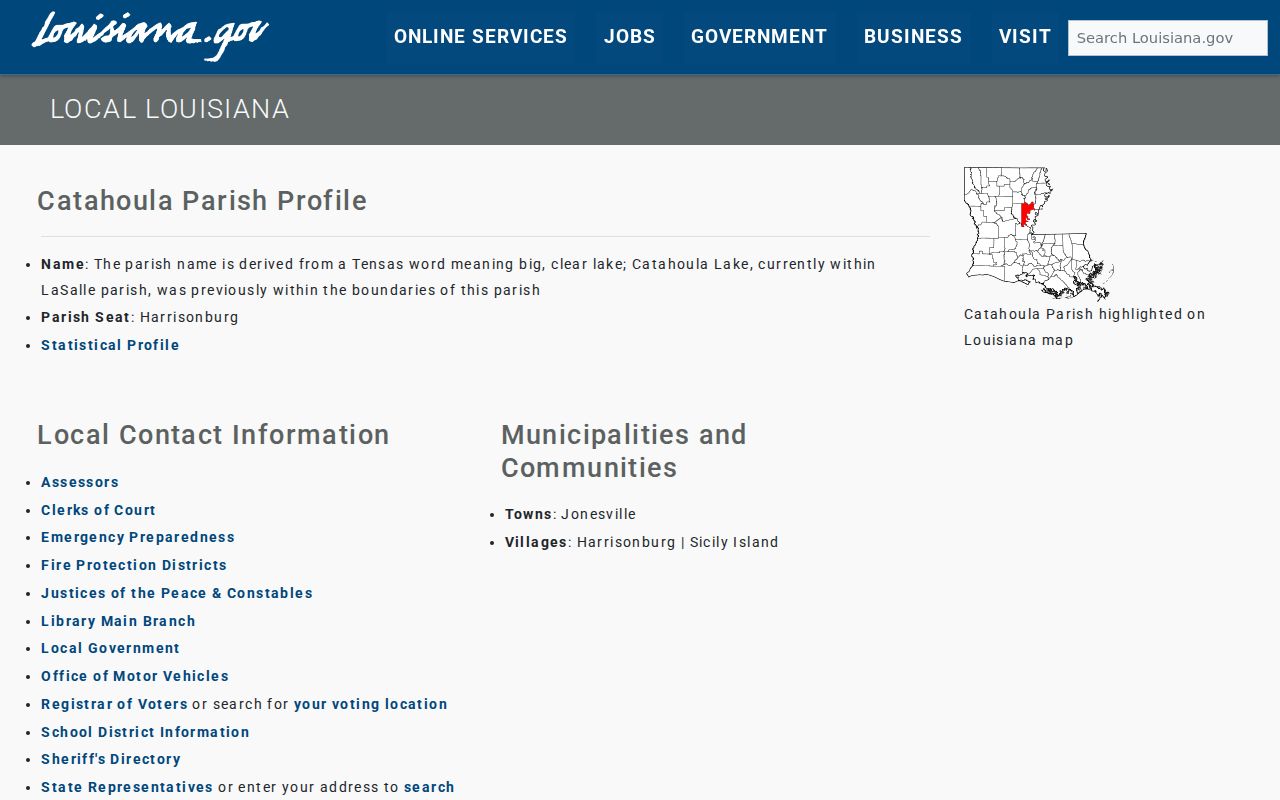
Use that directory to confirm jurisdiction before sending a record request.
Official Louisiana Background Checks
The Louisiana State Police Bureau of Criminal Identification and Information maintains the Louisiana Computerized Criminal History system, or LACCH. It is fingerprint-linked and is not an unrestricted public name-search database. An individual reviews a personal Louisiana record through Right to Review under R.S. 15:588, with fingerprints captured through the Louisiana Applicant Processing Solution.
Mail delivery is appropriate when a raised-seal paper copy is needed. Electronic delivery arrives through a secure link that lasts 30 days, allows one access, must be retrieved and printed from a computer, and cannot be downloaded to a mobile device. A separate FBI Identity History Summary covers a subject's federal fingerprint record; it does not replace parish court research.
Own-Record Review Through LAPS
Right to Review is the official route for checking one's fingerprint-based Louisiana history. The applicant schedules through LAPS, selects paper or electronic delivery, supplies identity and contact information, and attends fingerprint capture. No official LAPS site inside Catahoula Parish was verified, so the scheduler determines the available location.
| Product | Published amount | Note |
|---|---|---|
| Louisiana state background check | $31 | Includes the current $5 technology fee. |
| LAPS capture service | Not verified | Confirm in the appointment flow. |
| FBI Identity History Summary | Check current FBI page | Separate federal subject-only product. |
| Catahoula local check | Not published | Ask the sheriff whether one is offered. |
If LACCH omits a disposition, BCII calls for an original, unaltered certified clerk or district-attorney document matching the arrest and demographic information. An informal docket summary is not the documented correction route.
Paper and electronic Right to Review copies serve different practical needs. LSP prints, signs, marks, and embosses the mailed copy as a True Copy, which is the better selection when a raised seal is required. The electronic report carries a digital signature and True Copy marking, but the secure link allows one access, expires after 30 days, and must be opened and printed on a computer. Losing the appointment security answer requires a new appointment. An authorized representative or attorney uses a separate representative form and must be identified in the scheduling and delivery details.
A person physically unable to attend a digital capture site may use the documented mail alternative with fingerprint cards and the required Right to Review authorization and disclosure forms. Sensitive identity fields belong only in official secure channels. The $31 amount is the published state background-check charge on the current authorization form; it should not be represented as a complete LAPS appointment total where the site-service charge has not been verified.
The LSP BCII page explains the state repository responsible for Louisiana criminal history.
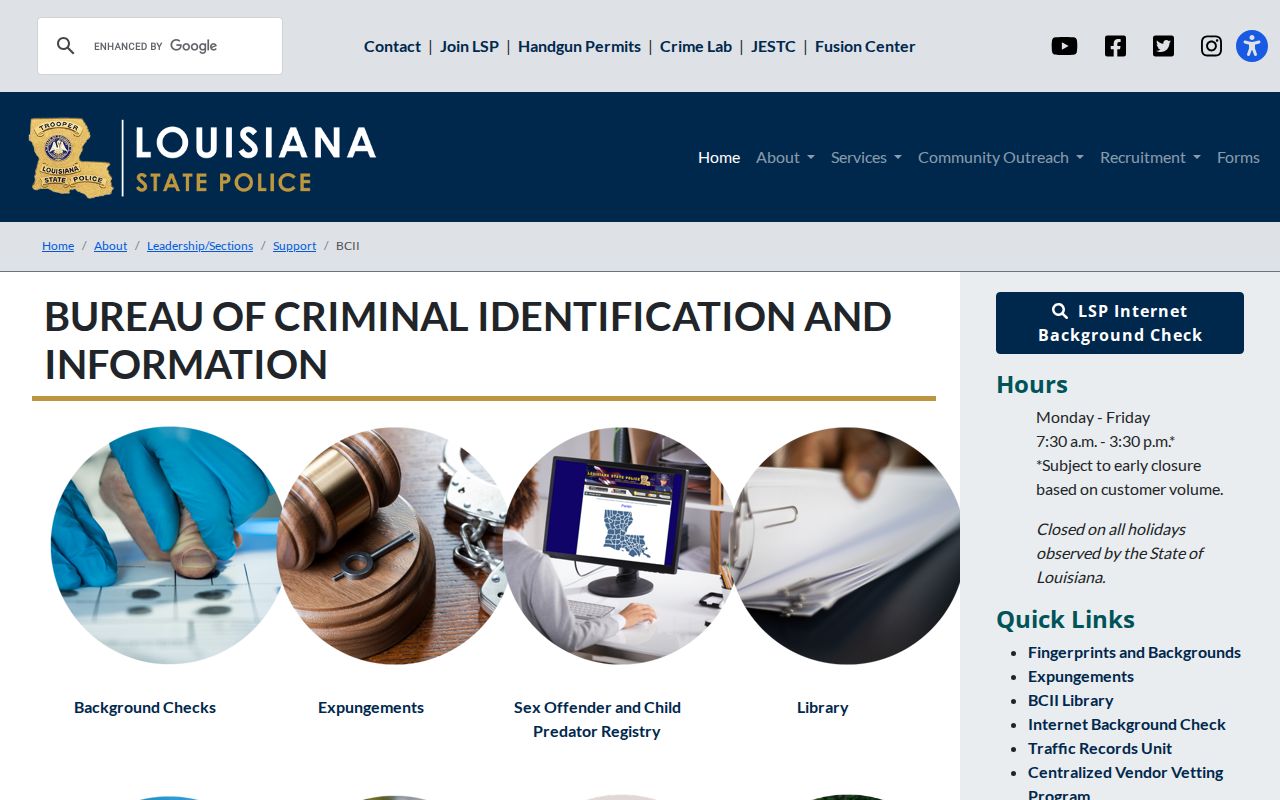
That repository source is distinct from the parish clerk's public court file.
Types of Criminal Records in Catahoula Parish
Record type determines custodian. An investigating agency creates the incident report; the jail creates the booking record; the district attorney files a bill of information or presents a matter for indictment; and the clerk preserves pleadings, minutes, orders, judgment, and sentence. Louisiana State Police builds a statewide arrest cycle when fingerprints and later dispositions reach LACCH.
Warrants may be tracked by both the issuing court and executing agency. Local custody belongs with the Parish Jail or Correctional Center, while Louisiana DPS&C and LA VINE supply state custody or community-supervision information. A registry profile is limited to people legally required to register and is not a general offense search.
- Arrest and booking records - show intake allegations, identifiers, bond, and custody events without proving guilt.
- Criminal court case files - show filed charges, hearings, pleadings, rulings, and the final disposition.
- Conviction and rap-sheet entries - link fingerprint-supported arrest cycles to reported outcomes and supervision events.
- Warrants - may include court-issued bench warrants, capiases, and agency-held arrest warrants, subject to access limits.
- Supervision and registry records - answer present probation, parole, custody, or statutory registration questions through specialized systems.
An incident report and a booking record are also separate. The report describes the reported event, people, property, evidence, and officer actions; the jail intake captures identity, fingerprints, photograph, alleged charges, property, bond, and custody events. A bill of information or indictment is the formal charging record. Grand-jury deliberations remain secret even when an indictment becomes part of the court case. A warrant may remain restricted while unexecuted or sealed. These distinctions explain why a broad request to one office often returns only part of the history.
Inside the 1930 Courthouse Records Stack
The courthouse at 301 Bushley Street concentrates several record offices in one Neoclassical building. Clerk Larisa Holley Field is in Room 101, the sheriff is identified in Room 105, judges sit upstairs, and District Attorney Bradley R. Burget's parish office is on the third floor. The arrangement mirrors a case's route from arresting agency to prosecutor, court, and permanent clerk file.
Clerk of Court
Room 101 · 318-744-5497
Case files, certified dispositions, and expungement filings.
Sheriff and Jail
301 Bushley Street · 318-744-5411
Incident routing, booking records, and local custody.
District Attorney
Third Floor · 318-744-5232
Prosecution functions, not the clerk's archive.
Call before traveling to confirm hours, document availability, identification rules, fees, and entrance. A statewide directory lists the sheriff at 100 Pine Street while the office's own footer uses 301 Bushley, making advance confirmation prudent.
The clerk is the legal custodian of the court file under Code of Civil Procedure article 251. A searcher can ask about inspection, ordinary copies, and certified copies, but should not assume privately owned scanning equipment may be used without a court order. The clerk's official contact page and Fees/Forms page are better starting points than an unofficial aggregator because they connect directly to the office responsible for the docket and the current expungement packet.
The district attorney's office handles felony, misdemeanor, traffic, worthless-check, and other prosecution functions, yet it is not a substitute for the clerk's public case archive. Likewise, the District 7 public defender represents qualifying accused people but is not a public-record custodian. Directing each question to the office that owns it avoids unnecessary disclosure of personal information and reduces referrals among courthouse floors.
The Catahoula Clerk's official website is the direct source for court contacts and linked services.
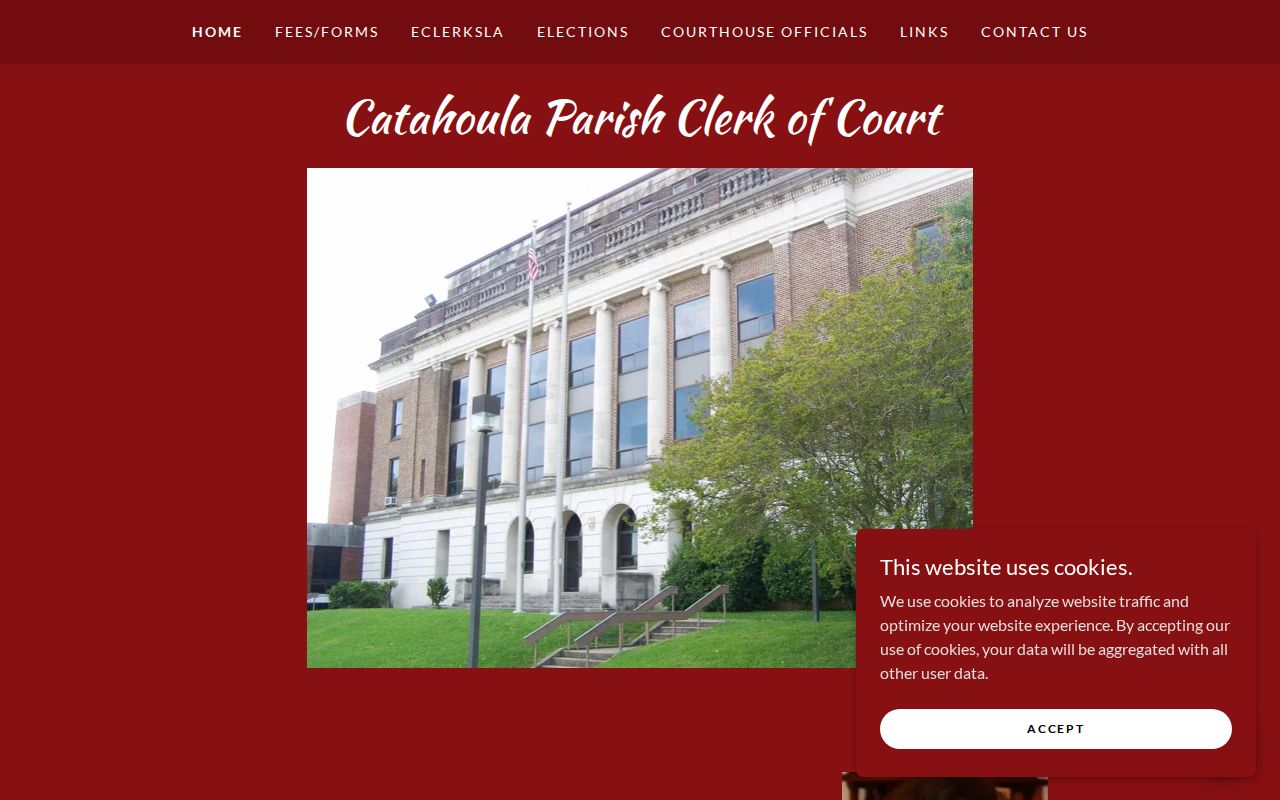
Its contact page supplies the courthouse routing details used for case requests.
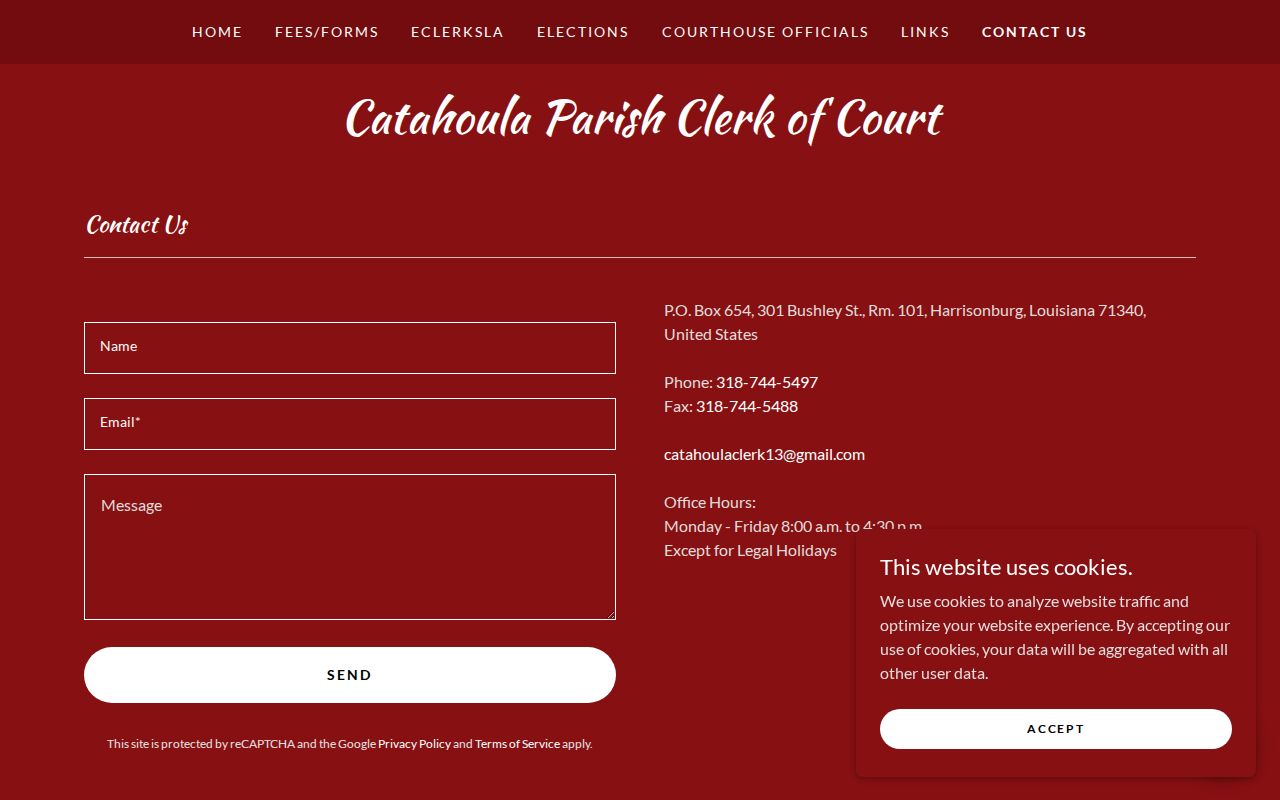
Confirm current access and copy arrangements with the clerk before visiting.
What a Catahoula Parish Criminal Record Shows
Contents vary by source. A court file can connect a docket number to the charging instrument, minute entries, plea, verdict, judgment, and sentence. LACCH may connect names and aliases to a state identification number, fingerprints, arrest agency, original and amended charges, dispositions, incarceration, probation, or parole. Protected identifiers are commonly redacted from public copies.
| Name & Identifiers | Legal name, aliases, birth details, case or booking number, and source-specific identity fields. |
|---|---|
| Arrest / Booking Data | Arresting agency, intake date, initial charge, photograph or fingerprints, bond, and custody events. |
| Charges & Statutes | Original allegations, prosecutor-filed counts, amended charges, and Louisiana statute references. |
| Disposition | Dismissal, nolle prosequi, acquittal, guilty plea, verdict, or another result for each count. |
| Sentence | Confinement, probation, fines, restitution, conditions, and whether terms run together or consecutively. |
| Custody / Supervision Status | Facility assignment, release information when published, and probation or parole events. |
Read every count separately. An original arrest label may be amended or reduced before judgment, and one case can contain a conviction on one count with dismissal or nolle prosequi on another. “Nolle prosequi” means the prosecutor formally declined to continue that charge at that time; it is not a guilty result. An acquittal follows adjudication and is likewise different from dismissal. Sentence fields may show custody, concurrent or consecutive terms, probation, restitution, fines, or other conditions. When an index abbreviates those events, request the judgment, sentence, and certified disposition.
The 30-Bed and 900-Capacity Facilities
Catahoula Parish Jail and Catahoula Correctional Center are not interchangeable names. The parish jail has a published capacity of 30 and was established in 1991. The Correctional Center on Old Columbia Road is described with 900 capacity and a larger corrections or transitional-work role. Capacity is not occupancy, and placement at either facility does not prove a Catahoula conviction.
Begin with Catahoula LAVNS. Its A–Z and “Show All” roster exposes limited identity and arrest-date columns, not a complete case outcome. For a transfer, release, bond detail, or absent result, call the sheriff and ask which facility holds the person and how to request a booking sheet. Use the clerk for prosecuted charges and disposition.
The DPS&C Catahoula directory distinguishes the parish's custody locations.
The directory supports facility routing but does not replace a live custody check.
The local roster's five visible fields—name, age, gender, race, and arrest date—do not establish the filed charge, bond amount, sentence, or release reason. Anonymous registration for custody notifications can help a victim or family member track a status change, but notification data is not a certified record. Louisiana's statewide telephone alternative at 225-383-4580 requires a DPS&C number or a name plus date of birth and may return an assignment, facility contact, and projected release information when applicable.
A correctional-center placement can arise from a transfer or corrections arrangement unrelated to the parish court being researched. Conversely, a Catahoula court case may exist even when the person is no longer in either local facility. The reliable chain is custody tool for present location, sheriff for the booking product, clerk for the case, and LSP Right to Review for the subject's fingerprint-linked Louisiana history.
Public Access Laws for Catahoula Parish Criminal Records
The Louisiana Public Records Law generally permits inspection and copying unless another law creates an exception. It does not turn every justice record into public information. Clerk records, initial police reports, statewide criminal-history data, juvenile files, active investigative material, and registry information each operate under different rules.
Key Statutes:
R.S. 44:31 - establishes inspection and copying rights unless another law controls.
R.S. 44:32 - governs custodian responses and limits inquiries into a requester's identity or purpose.
C.C.P. art. 251 - makes the clerk custodian of court records and authorizes examination and certified copies.
R.S. 15:587 - restricts LACCH dissemination rather than creating a public name search.
R.S. 15:588 - provides the personal review and challenge process for a Louisiana criminal history.
Louisiana law also narrows particular products. R.S. 15:587 controls dissemination from the central criminal-history repository to authorized criminal-justice and noncriminal-justice recipients; it does not authorize an unrestricted public LACCH name search. R.S. 15:588 gives the subject a way to review and challenge that state record. At the parish level, public-record rights remain subject to juvenile confidentiality, sealing and expungement, victim privacy, active-investigation protections, and removal of protected identifiers. Ask for segregable public portions when only part of a document is exempt.
Requesting a Record Without a Portal
The Sheriff's Office publishes no general request form, email, drop box, or mobile app. A request may begin by phone at 318-744-5411, fax at 318-744-5568, mail to P.O. Box 655, Harrisonburg, LA 71340, or an in-person inquiry at 301 Bushley Street. First confirm the sheriff created the record. A municipality may hold its incident report, while the clerk holds the disposition.
A useful request identifies an existing document: incident or booking date, location, report number if known, creating agency, involved party, desired format, and contact method. Ask for an itemized estimate because local copy fees and turnaround were not published. Do not ask the custodian to create a new analysis.
Initial report is not the whole investigation. R.S. 44:3 generally keeps initial reports, booking records, citations, and bills of information public while allowing protected follow-up investigation, sources, techniques, victim details, and juvenile material to be withheld or redacted.
Body-camera requests require reasonable incident specificity and can involve privacy review, judicial determinations, and production costs. Ask for the identifiable footage or report rather than “everything about” a person. The custodian may redact protected portions or withhold a qualifying investigative record while still releasing the public initial report. A denial or partial response should identify the legal basis that applies, allowing the requester to narrow or clarify the request.
Municipal records require another routing decision. Jonesville, Sicily Island, and Harrisonburg publish no dedicated online police-record form in the reviewed official sources. Contact the town or village government to identify the current creator and custodian. A municipal report or mayor's-court citation may stay local even if a related arrest produced a parish booking; a felony or state-law prosecution belongs with the Seventh JDC clerk.
The Legislative Auditor's parish inventory provides an official accountability trail for local public entities.
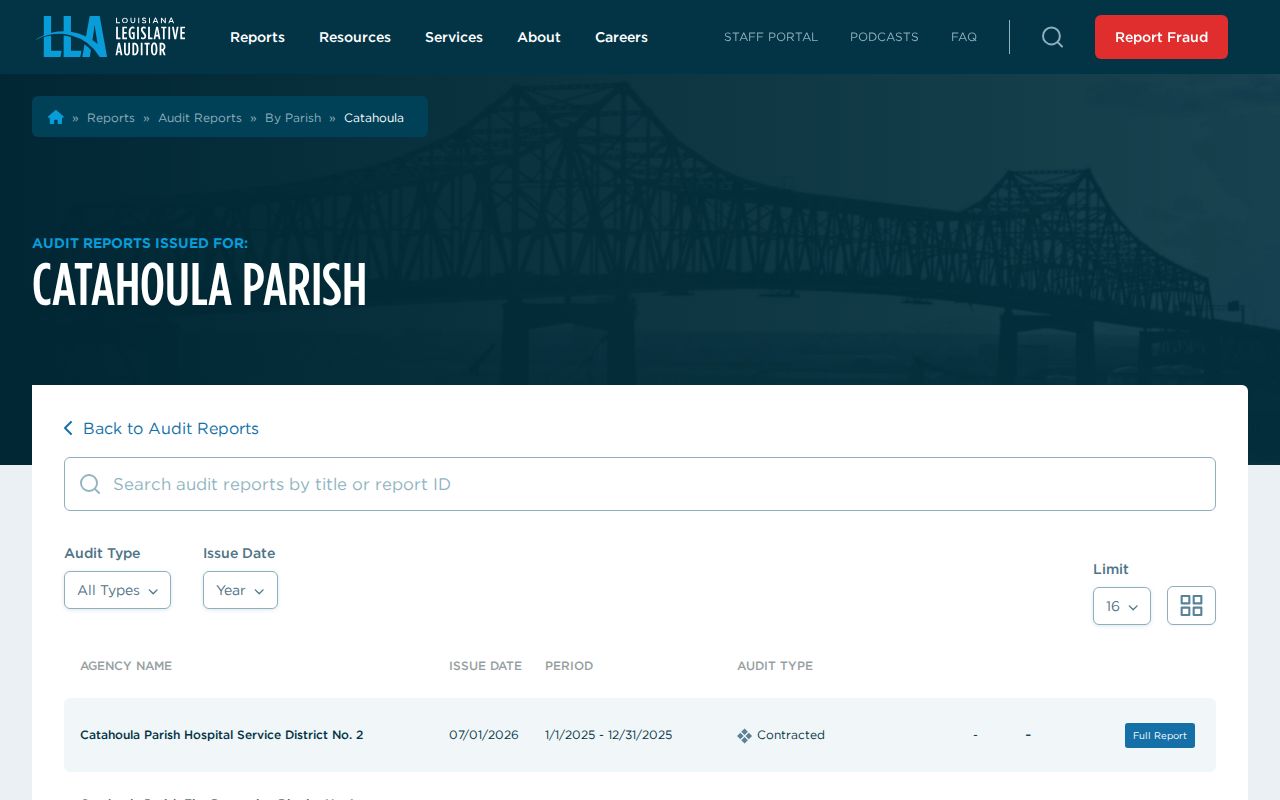
Audit materials can establish an office or program without proving that it maintains a current public search portal.
Sealed, Expunged, and Restricted Records
Louisiana expungement removes a qualifying record from ordinary public access; it does not mean every government copy is destroyed. Articles 971 through 995 govern eligibility, notice, fees, effects, and continued access by specifically authorized agencies. Juvenile records follow separate confidentiality rules, and protected victim, minor, medical, financial, or investigative information may be redacted without sealing the whole file.
The Catahoula Clerk publishes an expungement instructions and forms packet. Eligibility depends on the precise charge, disposition, sentence completion, waiting period, prior history, and statutory exclusions. Obtain a certified disposition first, confirm current fees with the clerk, and recheck both the public index and a later LSP Right to Review after an order is processed.
Criminal Records by City in Catahoula Parish
Jonesville, Sicily Island, and Harrisonburg are the parish's three incorporated municipalities. Each uses a mayor's court for ordinance matters, not a Louisiana city court. No official online municipal docket or arrest portal was located for any of them, so a local report or ordinance case begins with the municipal custodian by phone, counter visit, or focused public-record request. Parish booking goes to the sheriff and LAVNS; state-law prosecutions and certified outcomes go to the Seventh JDC clerk.
Jonesville Criminal History
1,728 residents in the 2020 Census · municipal records may remain local while bookings and district cases route to Harrisonburg.
Sicily Island Criminal History
366 residents in the 2020 Census · confirm the current village or sheriff custodian before requesting a report.
Harrisonburg Criminal History
277 residents in the 2020 Census · the parish seat contains the clerk, sheriff, courts, DA, and two distinct detention facilities.
All three local courts are mayor's courts under R.S. 33:441, with jurisdiction over municipal ordinance violations. They are not Louisiana city courts and do not become felony venues simply because a municipal arrest occurred. A reader tracing a Jonesville, Sicily Island, or Harrisonburg event may need three contacts: the municipal custodian for the initial report or ordinance citation, the sheriff or LAVNS for parish booking and custody, and Room 101 for a state-law prosecution and certified disposition. No municipal fee sheet, court search, arrest blotter, or downloadable request form was verified, so phone and counter routing should be described honestly rather than replaced with an invented link.
Population figures on the cards are April 1, 2020 Census counts, not current estimates. They provide scale only. The absence of a verified municipal crime table means no city rate should be inferred from isolated arrests, news reports, jail capacity, or roster results. When requesting a local record, provide the incident date, time and place, citation or report number, creating agency or officer if known, involved party, and desired format. Confirm the custodian and current contact before sending sensitive identifiers.
Expunged Does Not Mean Destroyed
Article 973 preserves access to expunged records for specified criminal-justice and statutorily authorized purposes. An empty public search therefore does not prove every agency copy vanished. Nor does a dismissal automatically remove an arrest cycle or correct a missing disposition in LACCH.
Obtain the certified disposition and personal Right to Review, match every arrest cycle and charge, examine the correct eligibility provision, and file the clerk's current packet. Keep certified copies of any order. After processing time, recheck the clerk index and LSP record. If the repository remains wrong, use BCII's certified-document correction process. Confirm filing, service, copy, and agency charges because the clerk publishes no complete parish-specific total.
Articles 976, 977, and 978 address different paths for non-convictions, misdemeanor convictions, and felony convictions. Eligibility turns on the actual offense and outcome, completion of sentence or deferred provisions, waiting period, prior history, and exclusions. The filing normally identifies the arresting agency, arrest date, charge, court and case, disposition, and agencies entitled to notice. The district attorney and arresting agency may object, and article 983 can require a contradictory hearing.
Restricted access also arises outside expungement. Juvenile records follow separate confidentiality and sealing provisions. Public copies generally omit Social Security numbers, financial-account data, protected victim and minor identifiers, and sensitive medical or investigative information. A redaction is not the same as sealing the entire file, and a sealed result is not necessarily destroyed.
Catahoula Records Across 708 Square Miles
Census QuickFacts estimates 8,223 residents as of July 1, 2025, down from 8,906 in 2020, across 708.03 square miles. That rural scale helps explain access through concentrated Harrisonburg offices, three municipal governments, state systems, and a regional probation office rather than one parish portal. The DPS&C Alexandria District serves Catahoula and five other parishes.
Population, facility capacity, roster entries, arrests, and court workload measure different things. No accessible official parish agency-level UCR table with confirmed coverage was located, so none should be converted into a crime rate. Federal records also remain separate: Catahoula lies in the Western District of Louisiana, and federal dockets belong in PACER, not eClerks LA.
The DPS&C inmate-information page explains statewide custody lookup and verification channels.
State custody information must still be separated from the local prosecution file.
Adult probation and parole are administered through Louisiana DPS&C rather than a parish probation department. Verification may require LA VINE, the DPS&C locator line, the clerk file for a probation sentence or revocation motion, the Alexandria District for information it may lawfully confirm, and Board or Committee material for parole decisions. Absence from a public locator is not proof that supervision never existed.
The DPS&C probation and parole directory identifies the regional office structure serving Catahoula.
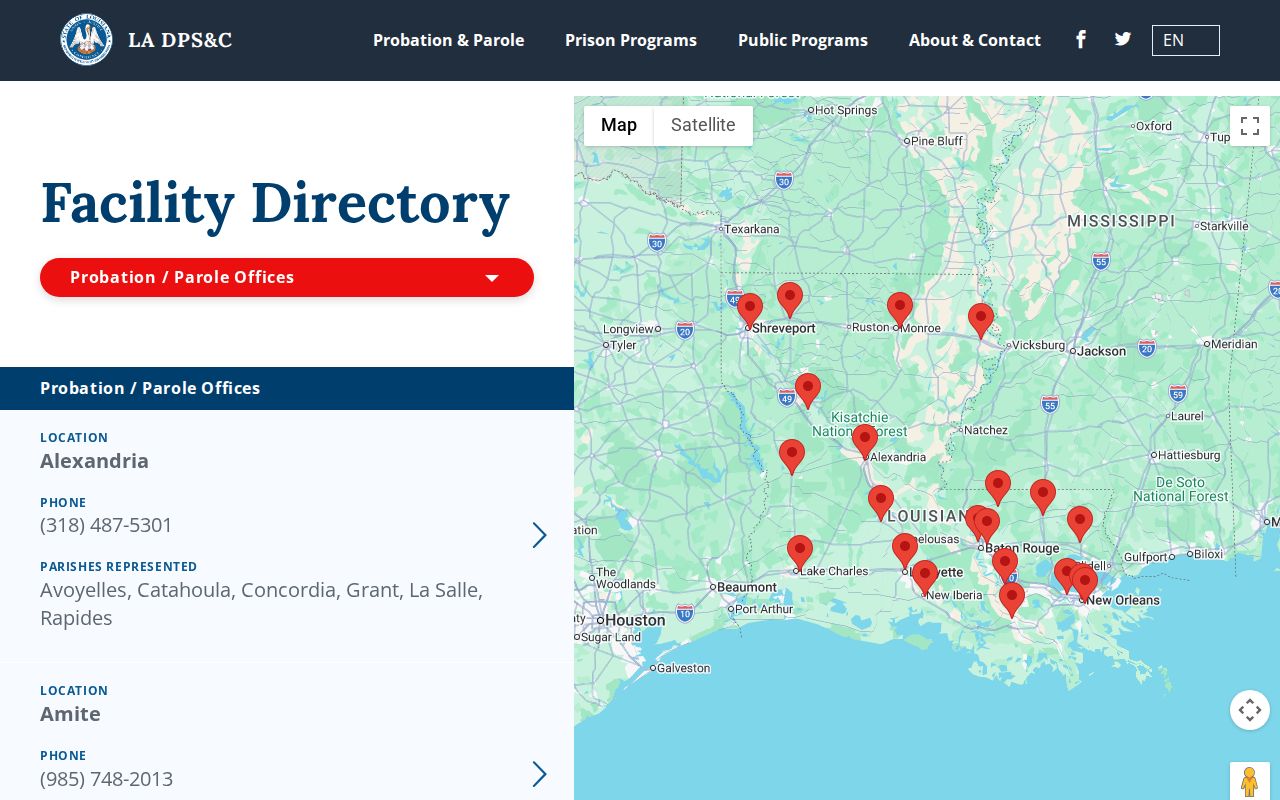
The Alexandria District is the regional supervision contact, not a parish court-record repository.
The parish's three incorporated places also sit at different points in the records geography. Jonesville is largest but is not the parish seat. Sicily Island has only a small municipal footprint in official sources. Harrisonburg has the smallest 2020 Census population of the three but contains the courthouse and detention facilities. Those facts explain routing; they do not justify assumptions about crime. Use verified official case, booking, custody, and registry records for the particular question.
The FBI Crime Data Explorer is the authoritative place to inspect reporting coverage before citing agency crime data.
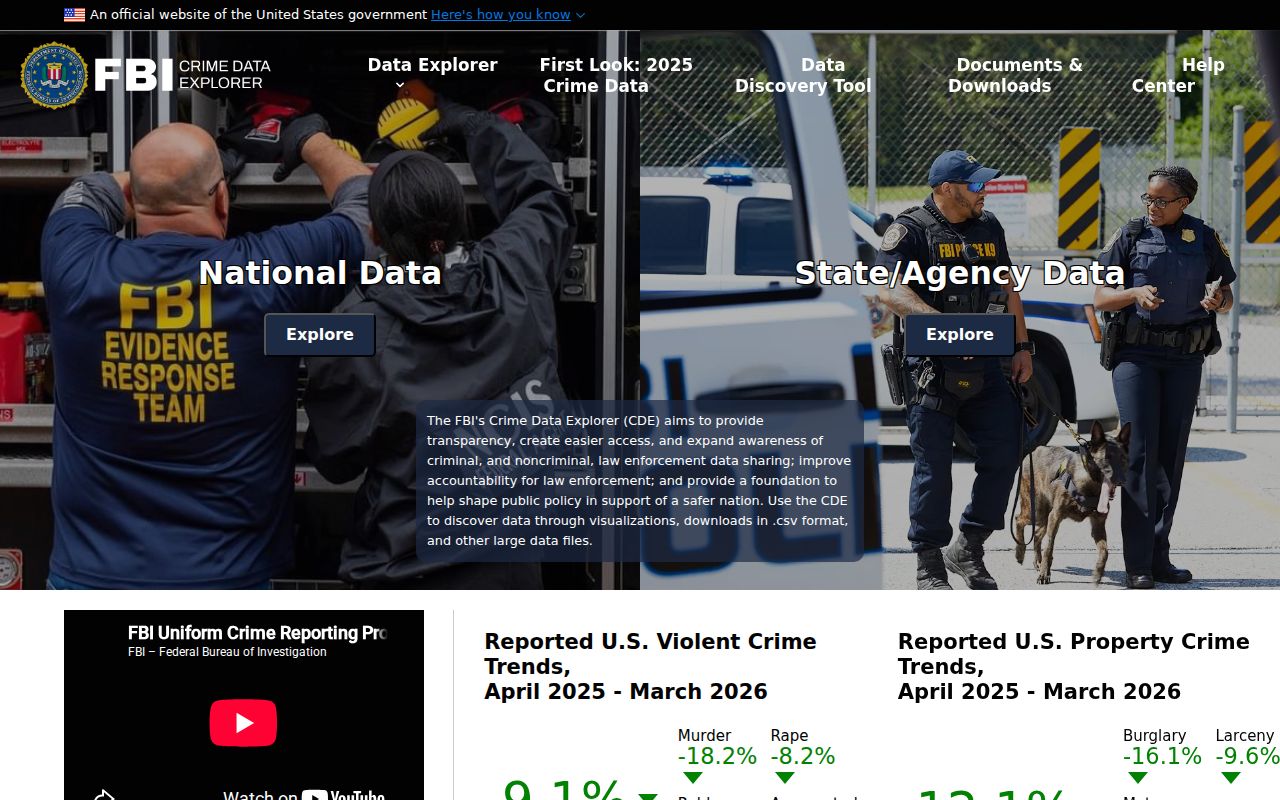
No parish rate should be published until the selected agency, year, and coverage are verified there.